Ozone for Drinking Water Disinfection: A Proven Alternative to Chlorine for Municipal and Bottled Water Treatment
Why Drinking Water Disinfection Matters More Than Ever
Access to safe drinking water remains one of the most critical public health challenges worldwide. According to the World Health Organization, over 2 billion people still lack access to safely managed drinking water services. For municipal water authorities and bottled water producers alike, choosing the right disinfection method is a decision that directly impacts public health, operational costs, and regulatory compliance.
While chlorine has been the dominant disinfectant for over a century, ozone disinfection has emerged as a superior alternative for drinking water treatment. With its powerful oxidizing capacity, absence of harmful byproducts, and ability to address a wider range of contaminants, ozone is increasingly recognized as the gold standard for modern water treatment facilities.
Ozone vs. Chlorine: A Comprehensive Comparison
Understanding the key differences between ozone and chlorine disinfection is essential for water treatment professionals evaluating technology upgrades. The following comparison highlights why many facilities are transitioning to ozone-based systems.
| Parameter | Ozone (O3) | Chlorine (Cl2) |
|---|---|---|
| Oxidation Power (ORP) | 2.07 V (strongest commercial oxidant) | 1.36 V |
| Disinfection Speed | Seconds to minutes | 30+ minutes contact time |
| Byproduct Formation | No harmful halogenated DBPs | Trihalomethanes (THMs), haloacetic acids |
| Taste & Odor Removal | Excellent (destroys geosmin, MIB) | Moderate (may cause chemical taste) |
| Residual Protection | Short half-life (~20 min); secondary disinfectant needed | Long-lasting residual in distribution |
| Microorganism Spectrum | Bacteria, viruses, protozoa (Cryptosporidium, Giardia) | Bacteria, some viruses; limited on protozoa |
| Environmental Impact | Decomposes to oxygen; zero discharge concern | Chlorine residuals toxic to aquatic life |
Key Insight: Ozone's oxidation potential of 2.07 V makes it 1.5 times more powerful than chlorine. This translates to faster disinfection, broader pathogen coverage, and significantly lower disinfection byproduct (DBP) formation — a critical advantage for facilities facing tightening regulations on THM and HAA5 limits.
How Ozone Disinfection Works in Drinking Water Systems
The Ozone Generation Process
In a typical municipal or bottled water treatment plant, ozone is generated on-site using a commercial ozone generator. The process begins with feeding oxygen gas (either from ambient air via an oxygen concentrator or from a pure oxygen supply) into the generator's corona discharge cell. High-voltage electrical energy splits oxygen molecules (O2) and recombines them into ozone (O3) at concentrations of 2–10% by weight.
The ozone gas is then introduced into the water stream through a bubble diffuser or venturi injector in a contact chamber. Contact time and ozone dose are carefully controlled based on water quality parameters and target pathogen inactivation levels. A typical municipal plant doses ozone at 1–3 mg/L with contact times of 4–10 minutes.
Multi-Barrier Treatment Approach
Best-practice drinking water treatment employs a multi-barrier approach. Ozone serves as the primary disinfection barrier, effectively inactivating resistant pathogens like Cryptosporidium parvum and Giardia lamblia that chlorine alone cannot reliably address. A secondary disinfectant (typically a low chlorine dose or UV) is then applied to maintain a residual throughout the distribution system, ensuring ongoing protection from recontamination.
Critical Advantages of Ozone for Drinking Water
1. Elimination of Disinfection Byproducts
Regulatory agencies worldwide are imposing stricter limits on disinfection byproducts. The US EPA Stage 2 Disinfectants and Disinfection Byproducts Rule mandates THM levels below 80 µg/L and HAA5 below 60 µg/L. The EU Drinking Water Directive sets even tighter THM limits at 100 µg/L with member states often enforcing lower thresholds. Ozone does not produce halogenated DBPs, making it the preferred solution for facilities struggling to meet these increasingly stringent standards.
2. Superior Taste and Odor Control
Algal blooms frequently produce geosmin and 2-methylisoborneol (MIB) — compounds that impart earthy, musty tastes and odors to water at detection thresholds as low as 10 ng/L. Chlorine is ineffective against these compounds and may even worsen taste by creating chemical flavors. Ozone oxidizes geosmin and MIB completely, producing water that is not only microbiologically safe but also organoleptically pleasant — a key quality attribute for bottled water brands competing on taste.
3. Effective Against Cryptosporidium and Giardia
Cryptosporidium oocysts are among the most resistant waterborne pathogens. Chlorine requires extremely high CT values (concentration × contact time) for inactivation — often impractical in real-world plant operations. Ozone achieves >99.9% inactivation of Cryptosporidium at practical CT values of 5–10 mg·min/L, making it the most effective single disinfectant against these protozoan parasites.
4. Enhanced Coagulation and Filtration
Ozone acts as a micro-flocculation aid by partially oxidizing organic molecules, causing them to polymerize and become more readily removed by subsequent coagulation and filtration steps. Studies show that pre-ozonation can reduce coagulant demand by 20–40% and improve turbidity removal efficiency, lowering overall treatment costs.
Sizing an Ozone System for Drinking Water Treatment
Proper ozone system sizing depends on water flow rate, target ozone dose, water quality, and the pathogen inactivation requirements. Below is a reference guide for common treatment capacities.
| Application Scale | Flow Rate | Ozone Dose | Required Ozone Output | Tonglin Model Recommendation |
|---|---|---|---|---|
| Small Bottled Water Plant | 1–5 m³/h | 1–2 mg/L | 2–10 g/h | CFY-5 / CFY-10 |
| Mid-size Bottled Water | 5–20 m³/h | 1.5–3 mg/L | 10–60 g/h | CFY-20 / CFY-50 |
| Small Municipal Plant | 50–200 m³/h | 2–3 mg/L | 100–600 g/h | 3S-100 / 3S-300 |
| Large Municipal Plant | 500+ m³/h | 2–4 mg/L | 1–5 kg/h | 3S-1000 / Custom |
Design Tip: Always size your ozone generator at 20–30% above calculated demand to account for seasonal water quality variations, transfer efficiency losses (typically 80–95% with fine-bubble diffusers), and future capacity expansion. Tonglin Ozone engineers can perform detailed CT calculations and system sizing based on your specific water quality data.
Regulatory Compliance and International Standards
Ozone disinfection for drinking water is endorsed by major regulatory and health organizations worldwide:
- US EPA — Recognized as a approved primary disinfectant under the Surface Water Treatment Rule (SWTR), with specific CT tables for Cryptosporidium, Giardia, and virus inactivation
- WHO Guidelines — Ozone recommended for drinking water treatment with maximum residual limit of 0.05 mg/L
- EU Drinking Water Directive — Permitted as a disinfectant with bromate limit of 10 µg/L (requires bromide monitoring when source water contains bromide)
- NSF/ANSI Standard 61 — Ozone generators certified for drinking water contact applications
- China GB 5749 — National drinking water standard permits ozone treatment with defined residual and bromate limits
When bromide is present in source water at levels above 50 µg/L, ozone can form bromate (BrO3-) as a secondary byproduct. Modern ozone systems address this by optimizing dose and contact time, or by implementing ammonia addition or pH adjustment strategies to suppress bromate formation below regulatory limits.
Bottled Water Industry: Why Premium Brands Choose Ozone
The global bottled water market, valued at over $350 billion in 2025, is driven by consumer expectations for purity, taste, and shelf stability. Ozone disinfection delivers on all three:
- Purity: Zero chemical residues — ozone decomposes to oxygen, leaving no taste-altering traces
- Taste: Complete removal of geosmin, MIB, and other organoleptic compounds
- Shelf Stability: Ozone-treated water exhibits extended shelf life due to thorough oxidation of bioavailable organics that could support microbial regrowth during storage
Premium bottled water brands such as Evian, Fiji, and many regional producers rely on ozone as their primary disinfection technology precisely because it preserves the water's natural character without introducing any foreign chemical signature.
Implementation Considerations for Water Treatment Professionals
Off-Gas Destruction
Not all ozone dissolves into water — typical transfer efficiency ranges from 80–95%. The remaining ozone in off-gas must be destroyed before release to meet occupational safety limits (OSHA PEL: 0.1 ppm). Catalytic or thermal destructors are standard components in professional ozone installations.
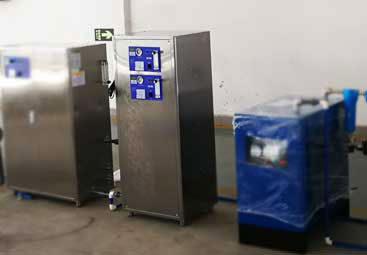
Integrated Ozone System Components
A complete ozone drinking water treatment system comprises several integrated components that must work together seamlessly:
- Ozone generator — Corona discharge unit producing ozone at required concentration and output
- Oxygen feed system — PSA oxygen concentrator (10–15% O3 from concentrated oxygen) or liquid O2 supply (up to 10% O3)
- Injection system — Venturi injector or bubble diffuser with contact tank for gas-to-liquid transfer
- Ozone contact chamber — Sized for required CT value with counter-current flow design
- Off-gas destructor — Catalytic or thermal unit destroying undissolved ozone
- Ozone residual monitor — Real-time dissolved ozone measurement for process control
Cost Considerations
While ozone system capital costs are higher than simple chlorine dosing equipment, total lifecycle costs are often lower. Reduced chemical purchases, eliminated DBP compliance risk, lower coagulant demand, and improved filtration performance collectively deliver ROI within 2–4 years for most municipal installations. For bottled water producers, ozone enables premium positioning that commands higher retail prices, making the investment self-funding through market differentiation.
Ready to Upgrade Your Drinking Water Disinfection?
Tonglin Ozone provides complete ozone disinfection systems for municipal water plants, bottled water facilities, and small-scale drinking water treatment projects worldwide. Our engineers will help you select the right ozone generator capacity, design the injection and contact system, and ensure full regulatory compliance.
Contact Tonglin Ozone for professional ozone solutions.
Email: l810185168@gmail.com
Phone/WhatsApp: 15818868390
-- End --
We found other products you might like!
Similar article ranking
- Cooperate with well-known brand Sophos
- Ozone Generator Sizing Calculator: How to Calculate the Right Size
- 10g/h vs 20g/h Ozone Generator: Which Size Do You Need?
- Ozone Generator for Gym and Fitness Center Air Purification in 2026
- Ozone Generator Maintenance Guide: Essential Care and Troubleshooting Tips
- Ozone Generator for Swimming Pool Water Treatment: Chemical-Free Pool Sanitizati
- Commercial Ozone Generator: Complete Guide for Businesses
- How Does Ozone Work in Swimming Pool Water Treatment?
- Hotel Room Ozone Disinfection Complete Guide 2026
- Ozone Generator for Drinking Water Treatment: Complete Implementation Guide
Ozone Equipment
- Portable Household Ozone Generator
- 50g-100g Ozone Generator
- 40g-100g ozone & oxygen machine
- SOZ-10G ozone generator
- 40g-200g ozone & oxygen machine
- OW Series Oxygen Generator
- DH-A Dryer
- Negative Pressure Ozone Generator
Ozone Application
- Residential Air purification Application
- ozone Application in wastewater treatment
- Ozone application in aquarium
- ozone Application in Pure water treatment
- Ozone Application in Aquaculture
- Ozone application in swimming pools
Latest news articles
- Ozone for Data Center Cooling Water: Biofouling Control, Energy Savings, and Sus
- How to Compare Ozone Generator Quotes: Reading Specifications Beyond the Price T
- Ozone Generator Power Supplies: How IGBT Inverter Technology Improves Output Sta
- Ozone Applications in Semiconductor Manufacturing: Wafer Cleaning, ALD Precursor
- Ozone for Pulp and Paper Mills: ECF-Complementary Bleaching, Whitewater Treatmen
- Ozone Off-Gas Destruction Systems: Thermal vs. Catalytic Destruct Units for Safe
- Ozone Sanitation for Seafood Processing Plants: Wash Water Reuse, Cross-Contamin
- Ozone vs. UV Disinfection for Water Treatment: A Practical Selection Guide for I
- Ozone Laundry Systems: How Cold-Water Ozone Washing Cuts Energy Costs for Hotels
- Total Cost of Ownership for Industrial Ozone Generators: A 10-Year Lifecycle Cos
- Ozone Mass Transfer Explained: Venturi Injectors, Bubble Diffusers, and Packed T
- Laboratory Ozone Exposure Systems: Controlled O3 Delivery for Biological, Medica
- Aquaculture Water Treatment: How Ozone Improves Fish Health and Biosecurity in C
- Case Study: Ozone Cooling Tower Retrofit Delivers 83% Chemical Savings and a 10-
- Ozone for Groundwater Treatment: Removing Iron, Manganese, and Hydrogen Sulfide
- Ozone Generator Control Systems Explained: PLC Automation, Remote Monitoring, an
- Ozone for Greenhouse Irrigation Water: Pathogen Control and Root Disease Prevent
- Industrial Ozone Systems: From 10 g/h to 200 g/h Output — A Sizing Guide for Wat
- Ozone in Pharmaceutical Water Systems: Purified Water, WFI Production, and Stora
- Industrial Ozone Generator Sizing: A Practical Calculation Guide for Water Treat