Oxygen-Integrated Ozone Generators: Why Oxygen-Fed Systems Outperform Air-Fed Units in Industrial Applications
Introduction: The Feed Gas Decision That Defines System Performance
When specifying an ozone generator for industrial water treatment, pharmaceutical sterilization, or laboratory research, one technical decision outweighs nearly all others: should the system be fed with dry air or oxygen? This single choice determines the maximum ozone concentration achievable, the energy efficiency of the generation process, the size of downstream piping, and ultimately the capital and operating costs of the entire system.
An oxygen-integrated ozone generator — sometimes called an oxygen-fed or PSA-integrated system — uses an onboard or external oxygen concentrator to deliver high-purity oxygen (typically 90–95% O₂) to the ozone generation chamber. The result is dramatically higher ozone concentrations, lower specific energy consumption, and a more compact system footprint. This article explains the physics, the economics, and the engineering rationale behind oxygen-fed ozone systems.
The Physics: Why Oxygen Feed Produces More Ozone
Ozone is generated when oxygen molecules (O₂) are dissociated by high-energy electrons in a corona discharge gap and recombine as ozone (O₃). In dry air, only about 21% of the gas molecules are oxygen — the remaining 79% is nitrogen, which does not contribute to ozone formation. Worse, nitrogen absorbs discharge energy that could otherwise go into splitting O₂ bonds.
When the feed gas is switched from air to 90–95% oxygen, the available oxygen increases more than fourfold. The discharge energy is concentrated on oxygen molecules, and the absence of nitrogen dramatically reduces parasitic energy losses. The net effects are:
- Ozone concentration increases from a typical air-fed maximum of 20–30 g/Nm³ to 100–200 g/Nm³ with oxygen feed.
- Specific energy consumption drops from approximately 15–25 kWh/kg O₃ (air-fed) to 8–12 kWh/kg O₃ (oxygen-fed).
- Nitrogen oxide (NOₓ) by-product formation is virtually eliminated, producing cleaner ozone with fewer corrosive residues.
- Gas volume for the same ozone mass is reduced by roughly 70%, allowing smaller contact tanks, pipework, and off-gas destructors.
Engineering Insight: The relationship between feed-gas oxygen purity and ozone yield is not linear. Above approximately 85% O₂ purity, the ozone concentration begins to rise steeply while energy consumption per gram of ozone drops sharply. This is why most industrial systems specify a PSA oxygen concentrator delivering ≥90% oxygen rather than relying on compressed air alone.
Comparative Performance: Air-Fed vs. Oxygen-Fed Systems
The table below summarizes the key performance differences between air-fed and oxygen-integrated ozone generators at a comparable 50 g/h output rating:
| Parameter | Air-Fed System | Oxygen-Integrated System |
|---|---|---|
| Feed Gas | Compressed dry air (21% O₂) | PSA oxygen (90–95% O₂) |
| Max Ozone Concentration | 20–30 g/Nm³ | 100–200 g/Nm³ |
| Specific Energy | 15–25 kWh/kg | 8–12 kWh/kg |
| Gas Volume at 50 g/h | ~2,000 L/min | ~300–500 L/min |
| NOₓ By-Products | Moderate (corrosive) | Negligible |
| Capital Cost | Lower (no O₂ concentrator) | Moderate (includes PSA unit) |
| Total 5-Year Operating Cost | Higher (more energy, more maintenance) | Lower (energy savings offset PSA cost) |
While the oxygen-integrated system carries a higher upfront capital cost due to the PSA oxygen concentrator, the total cost of ownership over 3–5 years is typically lower for any application requiring more than 20 g/h of continuous ozone output. The energy savings alone can recoup the PSA investment within 12–24 months for systems running 8+ hours per day.
How PSA Oxygen Integration Works
Pressure Swing Adsorption (PSA) Principle
Most oxygen-integrated ozone generators use a Pressure Swing Adsorption (PSA) oxygen concentrator. Ambient air is compressed, filtered, and passed through a zeolite molecular sieve bed. Zeolite preferentially adsorbs nitrogen at elevated pressure, allowing oxygen-enriched gas to pass through. When the bed is depressurized, the trapped nitrogen is released and the cycle repeats.
A typical PSA unit uses two alternating sieve beds to provide continuous oxygen delivery. The output is 90–95% pure oxygen at pressures of 2–5 bar, which is ideal for feeding a corona discharge ozone generator. The PSA unit can be integrated directly into the ozone system housing (for outputs up to ~50 g/h) or supplied as a separate skid-mounted module (for larger systems).
System Integration Architecture
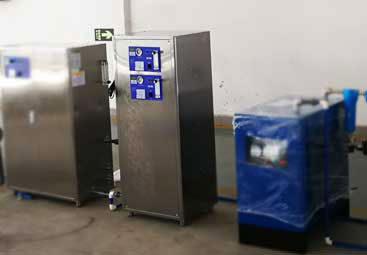
A complete oxygen-integrated ozone system consists of the following components in sequence:
- Air compressor with refrigerated dryer and particulate filtration
- PSA oxygen concentrator with dual zeolite beds and pressure regulation
- Ozone generator with corona discharge cell, high-voltage power supply, and cooling system
- Ozone injection system — venturi injector, diffuser, or bubble contactor depending on application
- Off-gas destructor with catalytic or thermal ozone destruction
Design Tip: For systems above 100 g/h, a dedicated oxygen receiver tank between the PSA and ozone generator is recommended. This buffers pressure fluctuations and ensures stable oxygen delivery, which directly translates to more consistent ozone concentration at the injection point.
When to Choose Oxygen-Integrated vs. Air-Fed
The decision between air-fed and oxygen-integrated ozone generation depends on the application requirements, the desired ozone concentration, and the total operating hours per year. The following guidelines help clarify the selection:
| Application Profile | Recommended System | Rationale |
|---|---|---|
| Small lab / pilot (< 10 g/h, intermittent use) | Air-fed | Low capital cost; PSA not cost-justified for occasional use. |
| Swimming pool / spa (10–30 g/h, continuous) | Oxygen-integrated | Higher concentration improves transfer efficiency; energy savings over 24/7 operation. |
| Drinking water / bottling (20–100 g/h) | Oxygen-integrated | Requires ≥80 g/Nm³ for effective disinfection in short contact time. |
| Pharmaceutical / cleanroom (all sizes) | Oxygen-integrated | NOₓ-free ozone essential; high concentration needed for sterilization. |
| Industrial wastewater (50–500 g/h) | Oxygen-integrated | Massive energy savings at scale; reduced off-gas volume. |
| Semiconductor / ALD research | Oxygen-integrated (high-purity) | Requires ultra-high concentration (≥150 g/Nm³) and zero nitrogen contamination. |
Maintenance Considerations for Oxygen-Integrated Systems
Oxygen-integrated ozone systems require slightly different maintenance routines compared to air-fed units. The PSA oxygen concentrator adds two periodic maintenance items:
- Zeolite sieve replacement: Every 3–5 years depending on air quality and operating hours. Contaminated feed air (oil vapor, moisture) can shorten sieve life significantly.
- Compressor filter replacement: Every 2,000–4,000 hours of operation. Clean intake air is critical to protect both the compressor and the zeolite bed.
In return, oxygen feed dramatically extends the life of the ozone generation cell itself. Because there is no nitrogen to form nitric acid residues inside the discharge gap, the dielectric tubes and electrodes experience less corrosion and fouling. Many oxygen-fed systems operate for 5+ years between cell overhauls, compared to 2–3 years for air-fed units in the same duty cycle.
Conclusion: The Clear Technical Advantage of Oxygen Integration
For any ozone application requiring continuous operation above 20 g/h, high ozone concentration, or ultra-clean ozone free of nitrogen by-products, an oxygen-integrated system is the technically superior choice. The higher capital investment is typically recovered through energy savings within the first one to two years, and the reduced gas volume simplifies downstream piping, contacting, and off-gas treatment design.
Tonglin Ozone manufactures a full range of oxygen-integrated ozone generators, from compact 10 g/h laboratory units with built-in PSA concentrators to skid-mounted industrial systems delivering 200+ g/h with external oxygen supply. All systems include integrated cooling, ozone concentration monitoring, and safety interlocks.
Contact Tonglin Ozone for Professional Ozone Solutions
Whether you need an oxygen-integrated industrial ozone generator or a compact laboratory system, Tonglin Ozone provides reliable equipment and expert technical support for customers in more than 60 countries.
Email: l810185168@gmail.com
Phone/WhatsApp: 15818868390
Ask about our oxygen-integrated ozone generator models and custom system design.
-- End --
We found other products you might like!
Similar article ranking
- Cooperate with well-known brand Sophos
- Ozone Generator Sizing Calculator: How to Calculate the Right Size
- 10g/h vs 20g/h Ozone Generator: Which Size Do You Need?
- Ozone Generator for Gym and Fitness Center Air Purification in 2026
- Ozone Generator Maintenance Guide: Essential Care and Troubleshooting Tips
- Ozone Generator for Swimming Pool Water Treatment: Chemical-Free Pool Sanitizati
- Commercial Ozone Generator: Complete Guide for Businesses
- How Does Ozone Work in Swimming Pool Water Treatment?
- Hotel Room Ozone Disinfection Complete Guide 2026
- Ozone Generator for Drinking Water Treatment: Complete Implementation Guide
Ozone Equipment
- Portable Household Ozone Generator
- 50g-100g Ozone Generator
- 40g-100g ozone & oxygen machine
- SOZ-10G ozone generator
- 40g-200g ozone & oxygen machine
- OW Series Oxygen Generator
- DH-A Dryer
- Negative Pressure Ozone Generator
Ozone Application
- Residential Air purification Application
- ozone Application in wastewater treatment
- Ozone application in aquarium
- ozone Application in Pure water treatment
- Ozone Application in Aquaculture
- Ozone application in swimming pools
Latest news articles
- Ozone for Data Center Cooling Water: Biofouling Control, Energy Savings, and Sus
- How to Compare Ozone Generator Quotes: Reading Specifications Beyond the Price T
- Ozone Generator Power Supplies: How IGBT Inverter Technology Improves Output Sta
- Ozone Applications in Semiconductor Manufacturing: Wafer Cleaning, ALD Precursor
- Ozone for Pulp and Paper Mills: ECF-Complementary Bleaching, Whitewater Treatmen
- Ozone Off-Gas Destruction Systems: Thermal vs. Catalytic Destruct Units for Safe
- Ozone Sanitation for Seafood Processing Plants: Wash Water Reuse, Cross-Contamin
- Ozone vs. UV Disinfection for Water Treatment: A Practical Selection Guide for I
- Ozone Laundry Systems: How Cold-Water Ozone Washing Cuts Energy Costs for Hotels
- Total Cost of Ownership for Industrial Ozone Generators: A 10-Year Lifecycle Cos
- Ozone Mass Transfer Explained: Venturi Injectors, Bubble Diffusers, and Packed T
- Laboratory Ozone Exposure Systems: Controlled O3 Delivery for Biological, Medica
- Aquaculture Water Treatment: How Ozone Improves Fish Health and Biosecurity in C
- Case Study: Ozone Cooling Tower Retrofit Delivers 83% Chemical Savings and a 10-
- Ozone for Groundwater Treatment: Removing Iron, Manganese, and Hydrogen Sulfide
- Ozone Generator Control Systems Explained: PLC Automation, Remote Monitoring, an
- Ozone for Greenhouse Irrigation Water: Pathogen Control and Root Disease Prevent
- Industrial Ozone Systems: From 10 g/h to 200 g/h Output — A Sizing Guide for Wat
- Ozone in Pharmaceutical Water Systems: Purified Water, WFI Production, and Stora
- Industrial Ozone Generator Sizing: A Practical Calculation Guide for Water Treat