Ozone for Textile Wastewater Treatment: Advanced Color Removal, COD Reduction, and Zero Liquid Discharge Support
The global textile industry generates over 1.5 billion cubic meters of wastewater annually, characterized by extreme color intensity, high chemical oxygen demand (COD), and persistent organic pollutants such as azo dyes and finishing agents. Conventional biological treatment often fails to meet stringent discharge limits, leaving manufacturers facing regulatory penalties and rising operational costs. Ozone oxidation has emerged as a powerful, chemical-free advanced oxidation process (AOP) that effectively decolorizes effluent, degrades refractory organics, and supports zero liquid discharge (ZLD) strategies for textile mills worldwide.
Why Textile Wastewater Is Particularly Challenging
Textile dyeing and finishing operations discharge complex effluent containing synthetic dyes, surfactants, heavy metals, and salts. Key challenges include:
- High color intensity: Reactive and disperse dyes absorb light strongly, making visual compliance impossible without >90% color removal.
- Refractory COD: Azo dyes and polymeric additives resist biological degradation, resulting in COD levels of 800–3,000 mg/L even after biological treatment.
- Variable composition: Batch processes change wastewater chemistry daily, requiring robust, adaptable treatment chemistry.
- Salinity and pH extremes: High salt loads and pH swings from 4 to 12 stress conventional coagulation and biological systems.
These characteristics make textile wastewater one of the most difficult industrial streams to treat to reuse or discharge standards.
How Ozone Breaks Down Dyes and Organic Pollutants
Ozone (O₃) is a potent oxidant with a standard oxidation potential of 2.07 V, second only to fluorine. In aqueous solution, ozone attacks organic molecules through two primary pathways:
Direct Molecular Oxidation
Ozone directly reacts with chromophore groups (—N═N—, —C═C— conjugated systems) in dye molecules, cleaving double bonds and destroying the conjugated structure responsible for color. This reaction is selective and fast, typically occurring in seconds to minutes under controlled pH.
Indirect Radical Chain Reactions
In alkaline conditions (pH > 8.5), ozone decomposes to generate hydroxyl radicals (•OH), which are non-selective and even more powerful (oxidation potential 2.80 V). These radicals mineralize organic intermediates into CO₂, H₂O, and inorganic salts, achieving true COD reduction rather than merely transferring pollutants to sludge.
Key Insight: Unlike coagulation/flocculation, which merely concentrates dyes into hazardous sludge, ozone oxidation destroys the dye molecules. This eliminates sludge disposal costs and secondary contamination risks—critical for textile manufacturers seeking sustainable operation and green certifications.
Treatment Performance: Color, COD, and Toxicity Reduction
Industrial-scale ozone systems for textile wastewater consistently achieve measurable results across multiple pollutant classes. The table below summarizes typical performance ranges based on published case studies and Tonglin Ozone field installations:
| Parameter | Influent Range | After Ozonation | Removal Efficiency |
|---|---|---|---|
| Color (ADMI / Pt-Co) | 500–3,000 | < 50 | 90–98% |
| COD (mg/L) | 800–2,500 | 150–500 | 60–85% |
| BOD₅ (mg/L) | 200–800 | 80–200 | 50–70% |
| Aromatic Amines (mg/L) | 5–50 | < 1 | 95–99% |
| Toxicity (LC₅₀, %) | High (lethal) | Low (non-lethal) | Significant reduction |
| pH | 4–12 | 6.5–8.5 | Self-neutralizing |
The combination of high color removal and substantial COD reduction makes ozone ideal for textile mills operating in jurisdictions with strict environmental discharge limits, such as EU REACH directives, China GB 4287-2012 standards, and Indian CPCB norms.
System Design: Integrating Ozone into Textile Effluent Treatment
Effective textile wastewater ozonation requires careful process integration. Tonglin Ozone recommends the following design framework for mills treating 100–5,000 m³/day of effluent:
1. Pre-Treatment Stage
Before ozone contact, effluent should pass through screening, equalization, and biological pre-treatment (if applicable). This reduces suspended solids and biodegradable organics, allowing ozone to focus on recalcitrant compounds. Typical pre-treated COD should be < 1,500 mg/L for optimal ozone economics.
2. Ozone Generation and Dosing
Corona discharge ozone generators with oxygen feed achieve concentrations of 80–150 mg/L, ideal for high-dose applications. For textile wastewater, typical ozone doses range from 0.5–2.0 g O₃ per liter of wastewater, depending on target color and COD levels. Multi-point injection improves mass transfer efficiency.
3. Contact System Selection
Bubble-diffuser contact towers with 5–7 meter height and 15–20 minutes hydraulic retention time provide cost-effective mass transfer. For higher efficiency, venturi injectors or turbine reactors can achieve >90% ozone utilization with shorter contact times. Post-contact off-gas destruction via catalytic or thermal destructors is mandatory for safety and environmental compliance.
4. Post-Treatment and Reuse
After ozonation, effluent may require pH adjustment, activated carbon polishing, or membrane filtration before reuse in dyeing processes or cooling tower makeup. The oxidized, low-toxicity effluent is particularly suitable for ZLD systems employing reverse osmosis (RO) and evaporative crystallization, since ozone pre-treatment significantly reduces membrane fouling.
Supporting Zero Liquid Discharge (ZLD) Goals
Zero liquid discharge is becoming a regulatory mandate in water-stressed regions and a sustainability target for leading textile brands. Ozone plays a critical role in ZLD train design by:
- Reducing organic fouling of RO membranes, extending membrane life by 30–50%.
- Improving brine quality for evaporative crystallizers, reducing scale and maintenance.
- Eliminating color and toxicity from the final brine or solid waste stream, ensuring landfill acceptability.
- Enabling water reuse in dyeing baths, reducing freshwater intake by up to 70% in closed-loop configurations.
Field Example: A denim washing facility in Southeast Asia integrated a 500 g/h oxygen-fed ozone system from Tonglin Ozone after biological treatment. The system achieved 96% color removal and 72% COD reduction at a dose of 1.2 g O₃/L. Post-ozone effluent was fed to an RO unit for reuse in stone-washing, cutting freshwater consumption by 65% and eliminating regulatory penalties for color discharge.
Cost-Benefit Analysis: Ozone vs. Conventional Methods
Textile manufacturers evaluating ozonation often compare it against activated carbon adsorption, coagulation with chemical flocculation, or advanced membrane processes. While ozone capital costs are moderate, the lifecycle economics are favorable:
| Cost Factor | Ozone AOP | Chemical Coagulation | Activated Carbon |
|---|---|---|---|
| Capital Investment | Medium | Low | High |
| Operating Chemical Cost | Low (O₂ only) | High (FeCl₃, polymers, lime) | High (carbon replacement) |
| Sludge Generation | Minimal | High (hazardous) | Moderate |
| Color Removal | Excellent (>95%) | Variable (60–85%) | Good (80–95%) |
| COD Removal | High (60–85%) | Low–Moderate | Moderate (adsorption-limited) |
| Environmental Footprint | Low (green) | High (chemical residues) | Moderate (spent carbon disposal) |
For facilities with daily wastewater volumes exceeding 500 m³, the elimination of chemical purchasing and sludge handling often delivers full ROI on ozone equipment within 18–30 months.
Equipment Selection: Sizing Ozone Systems for Textile Mills
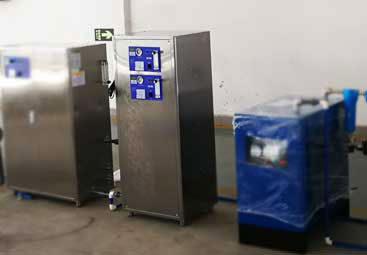
Tonglin Ozone manufactures industrial ozone generators specifically engineered for high-duty-cycle wastewater applications. Key selection criteria include:
- Capacity scaling: Systems from 50 g/h to 5 kg/h of ozone output, matched to peak hydraulic and pollutant loads.
- Oxygen source: Oxygen-fed systems (PSA or liquid O₂) deliver higher concentration and lower gas volume, reducing contactor footprint and energy consumption.
- Corrosion-resistant materials: 316L stainless steel, PTFE, and ceramic components withstand the aggressive, high-salt environment of textile effluent.
- Redundancy and control: Modular generator design with PLC-based ORP feedback ensures consistent dosing despite influent variability.
- CE-certified safety: Integrated off-gas destructors, ambient ozone monitors, and emergency shutdown systems comply with international machinery safety standards.
Conclusion
Ozone oxidation is a proven, scalable, and environmentally superior solution for textile wastewater treatment. By directly destroying dye chromophores and mineralizing refractory organics, ozone achieves color removal, COD reduction, and toxicity elimination without generating hazardous chemical sludge. For textile mills pursuing regulatory compliance, operational cost reduction, and zero liquid discharge targets, integrating ozone into the effluent treatment train is a strategic investment with measurable returns.
Contact Tonglin Ozone for Professional Ozone Solutions
Tonglin Ozone (Beijing) Equipment Co., Ltd. designs and manufactures industrial ozone generators for textile wastewater, water treatment, and process applications worldwide.
Email: l810185168@gmail.com
Phone/WhatsApp: 15818868390
-- End --
We found other products you might like!
Similar article ranking
- Cooperate with well-known brand Sophos
- Ozone Generator Sizing Calculator: How to Calculate the Right Size
- 10g/h vs 20g/h Ozone Generator: Which Size Do You Need?
- Ozone Generator for Gym and Fitness Center Air Purification in 2026
- Ozone Generator for Swimming Pool Water Treatment: Chemical-Free Pool Sanitizati
- Ozone Generator Maintenance Guide: Essential Care and Troubleshooting Tips
- Commercial Ozone Generator: Complete Guide for Businesses
- How Does Ozone Work in Swimming Pool Water Treatment?
- Hotel Room Ozone Disinfection Complete Guide 2026
- Ozone Generator for Drinking Water Treatment: Complete Implementation Guide
Ozone Equipment
- Portable Household Ozone Generator
- 50g-100g Ozone Generator
- 40g-100g ozone & oxygen machine
- SOZ-10G ozone generator
- 40g-200g ozone & oxygen machine
- OW Series Oxygen Generator
- DH-A Dryer
- Negative Pressure Ozone Generator
Ozone Application
- Residential Air purification Application
- ozone Application in wastewater treatment
- Ozone application in aquarium
- ozone Application in Pure water treatment
- Ozone Application in Aquaculture
- Ozone application in swimming pools
Latest news articles
- Ozone Off-Gas Destruction Systems: Thermal vs. Catalytic Destruct Units for Safe
- Ozone Sanitation for Seafood Processing Plants: Wash Water Reuse, Cross-Contamin
- Ozone vs. UV Disinfection for Water Treatment: A Practical Selection Guide for I
- Ozone Laundry Systems: How Cold-Water Ozone Washing Cuts Energy Costs for Hotels
- Total Cost of Ownership for Industrial Ozone Generators: A 10-Year Lifecycle Cos
- Ozone Mass Transfer Explained: Venturi Injectors, Bubble Diffusers, and Packed T
- Laboratory Ozone Exposure Systems: Controlled O3 Delivery for Biological, Medica
- Aquaculture Water Treatment: How Ozone Improves Fish Health and Biosecurity in C
- Case Study: Ozone Cooling Tower Retrofit Delivers 83% Chemical Savings and a 10-
- Ozone for Groundwater Treatment: Removing Iron, Manganese, and Hydrogen Sulfide
- Ozone Generator Control Systems Explained: PLC Automation, Remote Monitoring, an
- Ozone for Greenhouse Irrigation Water: Pathogen Control and Root Disease Prevent
- Industrial Ozone Systems: From 10 g/h to 200 g/h Output — A Sizing Guide for Wat
- Ozone in Pharmaceutical Water Systems: Purified Water, WFI Production, and Stora
- Industrial Ozone Generator Sizing: A Practical Calculation Guide for Water Treat
- The 7th Generation Quartz Discharge Tube: Engineering Breakthroughs for Higher O
- Ozone for Hospital and Pharmaceutical Wastewater Treatment: Pathogen Control, AP
- Ozone in Recirculating Aquaculture Systems (RAS): Water Quality, Biosecurity, an
- Customer Case Study: Ozone Disinfection in a Beverage Bottling Plant — Water Tre
- Ozone Treatment Standards for Bottled Water Plants: A Technical Guide to FDA, IB