Ozone in Recirculating Aquaculture Systems (RAS): Water Quality, Biosecurity, and System Design Guide for Fish Farmers
Recirculating Aquaculture Systems (RAS) represent the future of sustainable fish farming, allowing producers to raise high-density aquatic species in controlled, land-based environments with minimal water exchange. However, the closed-loop nature of RAS creates a critical challenge: water quality degradation from accumulated organic waste, ammonia, nitrite, and pathogenic microorganisms. Ozone treatment has emerged as one of the most effective water conditioning technologies for modern RAS facilities, providing simultaneous disinfection, water clarification, and organic matter oxidation without leaving harmful chemical residues.
Why Ozone Is Essential in Recirculating Aquaculture Systems
In a RAS facility, fish are typically stocked at densities of 30–80 kg/m³ or higher, meaning that metabolic waste products accumulate rapidly in the recirculating water. Uneaten feed, feces, and dissolved organic compounds create an environment where opportunistic pathogens thrive, water clarity drops, and fish health deteriorates. Traditional biofilters convert ammonia to nitrate but cannot remove dissolved organics or fine suspended solids.
Ozone (O₃) addresses multiple water quality parameters simultaneously. As a powerful oxidant with a redox potential of 2.07 V, ozone oxidizes dissolved organic matter, destroys bacteria and viruses, breaks down nitrite, and improves water clarity by causing micro-flocculation of fine particles. Unlike chlorine-based disinfectants, ozone decomposes into oxygen, leaving no toxic residues that could harm fish or biofilter performance.
Key Insight: In RAS operations, ozone serves a dual purpose — it acts as both a disinfectant for pathogen control and a water conditioner that improves overall water quality. This dual functionality reduces the need for multiple treatment steps, simplifying system design and lowering operating costs.
Water Quality Benefits of Ozone in RAS
1. Dissolved Organic Matter Removal
Fish excrete dissolved organic carbon (DOC) through gills and skin, and feed residues add further organic load. Accumulated DOC causes foaming, yellowish water discoloration, and reduces the effectiveness of UV sterilizers. Ozone oxidizes refractory organics into smaller, biodegradable fragments that biofilters can then process, effectively reducing the total organic carbon (TOC) load in the system.
2. Fine Solids Flocculation and Water Clarity
Fine suspended particles (below 30 μm) pass through mechanical filters and remain in the water column, reducing visibility and irritating fish gills. Ozone causes micro-flocculation — small particles aggregate into larger flocs that can be removed by foam fractionators or settlement tanks. Operators typically observe a 60–90% reduction in turbidity within hours of initiating ozone treatment.
3. Pathogen Reduction and Biosecurity
RAS systems are vulnerable to disease outbreaks because pathogens recirculate within the closed loop. Ozone is highly effective against a broad spectrum of aquaculture pathogens, including Vibrio species, Aeromonas salmonicida, white spot syndrome virus (WSSV), and various protozoan parasites. At an ozone dose of 0.1–0.3 mg/L residual concentration with a 2–3 minute contact time, most bacterial pathogens achieve >99.9% inactivation.
| Pathogen | Ozone Dose (mg/L) | Contact Time | Log Reduction |
|---|---|---|---|
| Vibrio anguillarum | 0.1 | 1 min | >3 log (99.9%) |
| Aeromonas salmonicida | 0.15 | 2 min | >4 log (99.99%) |
| White Spot Syndrome Virus | 0.5 | 5 min | >3 log (99.9%) |
| Saprolegnia parasitica (fungus) | 0.8 | 10 min | >2 log (99%) |
4. Nitrite Reduction
Nitrite (NO₂⁻) is highly toxic to fish at concentrations above 1.0 mg/L in freshwater systems. While biofilters eventually convert nitrite to nitrate, peak nitrite levels during system startup or after overfeeding can be lethal. Ozone directly oxidizes nitrite to nitrate (NO₃⁻), providing an immediate reduction in nitrite toxicity during critical periods.
Ozone Dosing Guidelines for RAS
Determining the correct ozone dose is critical for RAS operations. Over-dosing can harm fish gills and damage biofilter bacteria, while under-dosing fails to achieve the desired water quality improvements. The recommended approach is to dose based on feed loading rather than water volume, as organic load correlates directly with feed input.
| RAS Type | Stocking Density | Ozone Dose (g per kg feed/day) | Residual Target |
|---|---|---|---|
| Juvenile / Fingerling RAS | 20–30 kg/m³ | 5–10 g/kg feed | 0.05–0.1 mg/L |
| Grow-out RAS (medium density) | 40–60 kg/m³ | 10–20 g/kg feed | 0.1–0.2 mg/L |
| High-density Grow-out RAS | 60–100 kg/m³ | 15–30 g/kg feed | 0.2–0.3 mg/L |
| Shrimp / Broodstock RAS | 10–25 kg/m³ | 8–15 g/kg feed | 0.1–0.2 mg/L |
Important: Always monitor residual ozone levels at the outlet of the contact chamber, before water returns to fish tanks. Residual ozone concentrations above 0.5 mg/L at the fish tank inlet can cause gill damage. Install an ORP (Oxidation-Reduction Potential) sensor and maintain ORP values between 250–350 mV in the culture water for optimal results.
System Design: Integrating Ozone into RAS
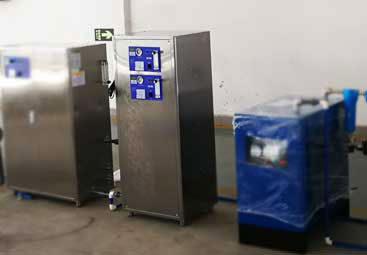
Proper integration of ozone equipment into a RAS facility requires careful planning of the treatment loop, contact time, and safety mechanisms. A typical ozone treatment loop in RAS includes the following components:
- Ozone generator: Corona discharge type, sized at 5–30 g ozone per kg of daily feed. PSA oxygen concentrators are recommended for systems requiring >10 g/h ozone output.
- Venturi injector or diffuser: Introduces ozone gas into the water stream with >90% mass transfer efficiency. Venturi injectors are preferred for their reliability and low maintenance.
- Contact tank: Provides 2–5 minutes of contact time for ozone reactions. Tank should be designed for plug-flow to prevent short-circuiting.
- Foam fractionator: Positioned after the contact tank to remove ozonized organic flocs and proteins. This also acts as an off-gas venting point.
- Ozone destructor: Catalytic or thermal destructor on the off-gas line to convert residual ozone back to oxygen before venting.
- ORP controller: Real-time monitoring and feedback control of ozone dosing, with alarm thresholds for high and low ORP.
Ozone vs. Other RAS Water Treatment Methods
| Parameter | Ozone | UV Sterilizer | Chlorine / Peroxide |
|---|---|---|---|
| Pathogen kill efficiency | Excellent (broad-spectrum) | Good (turbidity-dependent) | Moderate (selective) |
| DOC / Organics removal | Yes | No | Partial |
| Water clarity improvement | Significant | Minimal | Minimal |
| Chemical residue | None (decomposes to O₂) | None | Yes (toxic byproducts) |
| Effect on biofilter | Positive (reduces DOC load) | Neutral | Negative (can inhibit nitrifiers) |
Safety Considerations for Ozone in RAS
While ozone is a powerful tool, improper use in RAS can create risks to both fish and human operators. The following safety measures are essential:
- Residual ozone monitoring: Install dissolved ozone sensors or ORP controllers at the fish tank inlet. Set automatic shutoff if residual exceeds 0.3 mg/L.
- Off-gas management: All ozone contact tanks and foam fractionators must be sealed and vented through an ozone destructor. Ambient ozone levels in the facility should remain below 0.1 ppm (OSHA limit).
- Material compatibility: Use ozone-resistant materials (SS316L, PTFE, PVDF, EPDM) in all wetted components. Standard PVC and rubber degrade rapidly under ozone exposure.
- Gradual ramp-up: When starting ozone treatment for the first time, begin at 30% of the target dose and increase over 3–5 days to allow biofilter bacteria to acclimate.
ROI: Cost Benefits of Ozone in RAS Operations
Investing in ozone technology for a RAS facility delivers measurable returns through improved fish survival rates, reduced feed conversion ratios (FCR), lower medication costs, and extended equipment life. A typical 50-ton/year RAS facility can expect the following outcomes after implementing ozone treatment:
| Benefit Category | Without Ozone | With Ozone | Annual Savings (USD) |
|---|---|---|---|
| Fish mortality rate | 8–12% | 3–5% | $12,000–$20,000 |
| Feed Conversion Ratio | 1.4–1.6 | 1.1–1.3 | $8,000–$15,000 |
| Antibiotic / chemical use | Regular | Minimal | $5,000–$8,000 |
| Water exchange rate | 5–10% daily | 1–3% daily | $3,000–$6,000 |
For a 50-ton/year facility, total annual savings typically range from $28,000 to $49,000, while the capital cost of a complete ozone system (generator, oxygen concentrator, contact tank, controls) ranges from $8,000 to $25,000 depending on capacity. This translates to a payback period of 6–12 months in most commercial RAS operations.
Choosing the Right Ozone Generator for Your RAS
Selecting an ozone generator for aquaculture requires consideration of production capacity, feed gas type, concentration output, and control features. Tonglin Ozone manufactures a range of corona discharge ozone generators specifically designed for RAS and aquaculture applications, with capacities from 5 g/h to 500 g/h and optional integrated PSA oxygen concentrators. Key features include:
- Air-cooled or water-cooled options depending on ambient conditions and system size
- Adjustable output (10–100%) with ORP feedback control integration
- Built-in oxygen concentrator (PSA) for systems requiring high ozone concentration (>80 g/m³)
- SS316L ozone-resistant wetted parts and PTFE tubing throughout
- CE-certified components and leak detection with automatic safety shutoff
Ready to Optimize Your RAS Water Quality with Ozone?
Tonglin Ozone provides turnkey ozone systems for recirculating aquaculture, from 5 g/h lab-scale units to 500 g/h commercial installations. Contact our engineering team for a free system sizing consultation.
Contact Tonglin Ozone for professional ozone solutions.
Email: l810185168@gmail.com
Phone/WhatsApp: 15818868390
-- End --
We found other products you might like!
Similar article ranking
- Cooperate with well-known brand Sophos
- Ozone Generator Sizing Calculator: How to Calculate the Right Size
- 10g/h vs 20g/h Ozone Generator: Which Size Do You Need?
- Ozone Generator for Gym and Fitness Center Air Purification in 2026
- Ozone Generator for Swimming Pool Water Treatment: Chemical-Free Pool Sanitizati
- Ozone Generator Maintenance Guide: Essential Care and Troubleshooting Tips
- Commercial Ozone Generator: Complete Guide for Businesses
- How Does Ozone Work in Swimming Pool Water Treatment?
- Hotel Room Ozone Disinfection Complete Guide 2026
- Ozone Generator for Drinking Water Treatment: Complete Implementation Guide
Ozone Equipment
- Portable Household Ozone Generator
- 50g-100g Ozone Generator
- 40g-100g ozone & oxygen machine
- SOZ-10G ozone generator
- 40g-200g ozone & oxygen machine
- OW Series Oxygen Generator
- DH-A Dryer
- Negative Pressure Ozone Generator
Ozone Application
- Residential Air purification Application
- ozone Application in wastewater treatment
- Ozone application in aquarium
- ozone Application in Pure water treatment
- Ozone Application in Aquaculture
- Ozone application in swimming pools
Latest news articles
- Ozone Off-Gas Destruction Systems: Thermal vs. Catalytic Destruct Units for Safe
- Ozone Sanitation for Seafood Processing Plants: Wash Water Reuse, Cross-Contamin
- Ozone vs. UV Disinfection for Water Treatment: A Practical Selection Guide for I
- Ozone Laundry Systems: How Cold-Water Ozone Washing Cuts Energy Costs for Hotels
- Total Cost of Ownership for Industrial Ozone Generators: A 10-Year Lifecycle Cos
- Ozone Mass Transfer Explained: Venturi Injectors, Bubble Diffusers, and Packed T
- Laboratory Ozone Exposure Systems: Controlled O3 Delivery for Biological, Medica
- Aquaculture Water Treatment: How Ozone Improves Fish Health and Biosecurity in C
- Case Study: Ozone Cooling Tower Retrofit Delivers 83% Chemical Savings and a 10-
- Ozone for Groundwater Treatment: Removing Iron, Manganese, and Hydrogen Sulfide
- Ozone Generator Control Systems Explained: PLC Automation, Remote Monitoring, an
- Ozone for Greenhouse Irrigation Water: Pathogen Control and Root Disease Prevent
- Industrial Ozone Systems: From 10 g/h to 200 g/h Output — A Sizing Guide for Wat
- Ozone in Pharmaceutical Water Systems: Purified Water, WFI Production, and Stora
- Industrial Ozone Generator Sizing: A Practical Calculation Guide for Water Treat
- The 7th Generation Quartz Discharge Tube: Engineering Breakthroughs for Higher O
- Ozone for Hospital and Pharmaceutical Wastewater Treatment: Pathogen Control, AP
- Ozone in Recirculating Aquaculture Systems (RAS): Water Quality, Biosecurity, an
- Customer Case Study: Ozone Disinfection in a Beverage Bottling Plant — Water Tre
- Ozone Treatment Standards for Bottled Water Plants: A Technical Guide to FDA, IB