Ozone for Hospital and Pharmaceutical Wastewater Treatment: Pathogen Control, API Removal, and Discharge Compliance
Hospital and pharmaceutical manufacturing wastewater is among the most challenging industrial effluents to treat safely. It contains a complex mixture of pathogenic microorganisms, high organic loads, and biologically active pharmaceutical ingredients (APIs) such as antibiotics, hormones, cytostatics, and analgesics. Conventional biological treatment often fails to degrade these persistent compounds, while chlorine disinfection can create harmful disinfection byproducts. Ozone treatment has become a leading advanced oxidation and disinfection technology for medical and pharma wastewater, offering simultaneous pathogen inactivation, API degradation, and odor control without leaving toxic residues.
Why Hospital and Pharmaceutical Wastewater Requires Advanced Treatment
Unlike typical municipal sewage, effluent from hospitals, clinics, and pharmaceutical plants carries elevated concentrations of contaminants that standard wastewater plants are not designed to remove. These include:
- Pathogenic microorganisms: Bacteria, viruses, fungi, and antibiotic-resistant strains such as MRSA and VRE, with infection risks for plant operators and downstream water users.
- Active pharmaceutical ingredients (APIs): Residual antibiotics, hormones, cytostatics, and contrast media that disrupt aquatic ecosystems and contribute to antimicrobial resistance.
- High organic and nitrogen loads: Blood, bodily fluids, disinfectants, solvents, and cleaning chemicals create variable COD/BOD and nutrient spikes.
- Cytotoxic and radioactive traces: Oncology ward wastewater may contain genotoxic substances that require specialized handling before discharge.
Because these streams are highly variable in flow and composition, treatment must be robust, reliable, and capable of responding to shock loads. Ozone provides a flexible, chemical-free solution that can be integrated upstream of biological treatment, as a polishing step, or as part of an Advanced Oxidation Process (AOP).
How Ozone Works in Medical and Pharma Wastewater
Ozone (O₃) is a powerful oxidant with a redox potential of 2.07 V. It attacks contaminants through two primary mechanisms:
- Direct molecular oxidation: Ozone reacts directly with unsaturated bonds, aromatic rings, and nucleic acids, destroying pathogens and breaking down APIs into smaller, less harmful molecules.
- Indirect hydroxyl radical generation: In AOP configurations, ozone combined with UV or hydrogen peroxide produces hydroxyl radicals (•OH), which have an even higher oxidation potential and are effective against refractory organics.
After reaction, residual ozone rapidly decomposes to oxygen, leaving no chlorinated byproducts such as trihalomethanes (THMs) or haloacetic acids (HAAs). This makes ozone particularly suitable for facilities targeting direct discharge, water reuse, or compliance with stringent hospital effluent standards.
Target Contaminants and Removal Performance
The table below summarizes typical ozone treatment performance for key contaminant groups found in hospital and pharmaceutical wastewater. Actual doses depend on influent quality, target removal, and whether ozone is used alone or in an AOP train.
| Contaminant Group | Typical Influent Load | Ozone Dose | Removal Efficiency | Contact Time |
|---|---|---|---|---|
| E. coli / Coliforms | 10³–10⁶ CFU/100 mL | 8–15 mg/L | >99.99% | 10–20 min |
| Antibiotic residues | 10–500 μg/L | 10–30 mg/L | 80–99% | 20–40 min |
| Hormones (e.g., estrone) | 0.1–5 μg/L | 5–15 mg/L | 85–98% | 15–30 min |
| Cytostatic drugs | 1–100 μg/L | 20–50 mg/L | 70–95% | 30–60 min |
| Enteric viruses | 10–10⁴ units/L | 10–20 mg/L | >99.9% | 15–25 min |
| COD reduction | 200–800 mg/L | 30–80 mg/L | 40–70% | 30–90 min |
For difficult-to-degrade cytostatics and high-strength pharmaceutical effluent, Tonglin Ozone engineers often recommend an O₃/UV or O₃/H₂O₂ AOP configuration to achieve >90% API removal while minimizing total ozone consumption.
Typical Ozone System Layout for Hospital Wastewater
A complete ozone treatment train for hospital or pharmaceutical effluent usually includes the following stages. Each component is selected based on flow rate, contaminant profile, and discharge target:
- Equalization tank: Balances hydraulic and organic shock loads from ward drains and batch pharma processes.
- Fine screening / filtration: Removes solids, hair, and fibers that shield microorganisms from ozone contact.
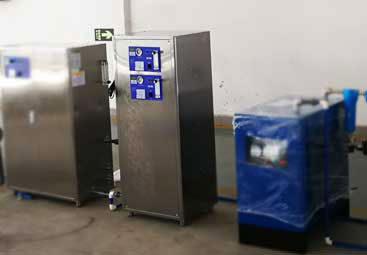
- Ozone generation and injection: Corona discharge ozone generator with PSA oxygen concentrator; ozone injected via venturi or fine-bubble diffuser.
- Contact reactor: Provides controlled residence time for pathogen inactivation and oxidation reactions; designed for plug-flow or multiple chambers.
- Residual ozone quenching: Activated carbon or catalytic destructor removes residual ozone before discharge to receiving water or reuse systems.
- Monitoring and control: ORP, dissolved ozone, flow, and pressure sensors with automated dose feedback for safe, consistent operation.
Regulatory Note: The World Health Organization (WHO), U.S. EPA, and EU Water Framework Directive all recognize ozone as an effective disinfectant and advanced oxidation process. Ozone does not form chlorinated disinfection byproducts, making it easier to meet tightening limits on THMs, HAAs, and trace pharmaceuticals in effluent discharge.
Key Advantages of Ozone Over Conventional Disinfection
Chlorine and UV are common alternatives, but each has limitations when treating hospital and pharmaceutical wastewater:
| Parameter | Ozone | Chlorine | UV |
|---|---|---|---|
| Pathogen inactivation | Excellent (broad-spectrum) | Good (some resistant cysts) | Good (turbidity-dependent) |
| API / micropollutant removal | Yes (degrades) | Limited | Partial (photolysis) |
| Harmful byproducts | None (O₃ → O₂) | THMs, HAAs, chloramines | None |
| Odor and color removal | Significant | Moderate | Minimal |
| Chemical storage risk | Low (on-site generation) | High (chlorine tanks) | Low |
Engineering Considerations for Safe, Reliable Operation
Designing an ozone system for medical wastewater requires attention to safety, materials compatibility, and process control. Critical factors include:
- Ozone-resistant materials: All wetted components should use SS316L, PTFE, PVDF, or EPDM. Standard PVC, Buna-N, and mild steel degrade rapidly under ozone exposure.
- Off-gas destruction: Ozone contact tanks must be sealed and vented through a catalytic or thermal destructor to maintain ambient ozone below 0.1 ppm.
- Dose pacing: ORP-based feedback control adjusts ozone output in real time based on influent load, preventing both under-treatment and excessive residual ozone.
- Operator safety: Install ambient ozone leak detectors, emergency shutdown systems, and lockable enclosures. Personnel should follow OSHA/NIOSH guidelines for ozone exposure limits.
- Pretreatment integration: High suspended solids or oils reduce ozone mass transfer; coagulation, flotation, or filtration should be placed upstream when needed.
Sizing Guidance for Hospital and Pharma Applications
Ozone generator capacity is sized based on peak flow, target ozone dose, and required safety factor. A typical hospital wastewater system treating 50–200 m³/day may require an ozone generator rated at 50–200 g/h with an integrated oxygen concentrator. For pharmaceutical manufacturing effluent with higher COD and API loads, systems from 200 g/h to 2 kg/h are common, often paired with UV for AOP enhancement.
Tonglin Ozone supplies corona discharge ozone generators from 5 g/h to 5 kg/h for hospital, laboratory, and pharmaceutical wastewater applications. Units are available with air-cooled or water-cooled power supplies, PSA oxygen integration, ORP feedback control, and CE-certified safety packages for international export.
Need a Hospital or Pharmaceutical Wastewater Ozone System?
Tonglin Ozone designs complete ozone treatment trains for medical effluent, API removal, and reuse-ready discharge. Contact us for a free technical consultation and system sizing.
Contact Tonglin Ozone for professional ozone solutions.
Email: l810185168@gmail.com
Phone/WhatsApp: 15818868390
-- End --
We found other products you might like!
Similar article ranking
- Cooperate with well-known brand Sophos
- Ozone Generator Sizing Calculator: How to Calculate the Right Size
- 10g/h vs 20g/h Ozone Generator: Which Size Do You Need?
- Ozone Generator for Gym and Fitness Center Air Purification in 2026
- Ozone Generator for Swimming Pool Water Treatment: Chemical-Free Pool Sanitizati
- Ozone Generator Maintenance Guide: Essential Care and Troubleshooting Tips
- Commercial Ozone Generator: Complete Guide for Businesses
- How Does Ozone Work in Swimming Pool Water Treatment?
- Hotel Room Ozone Disinfection Complete Guide 2026
- Ozone Generator for Drinking Water Treatment: Complete Implementation Guide
Ozone Equipment
- Portable Household Ozone Generator
- 50g-100g Ozone Generator
- 40g-100g ozone & oxygen machine
- SOZ-10G ozone generator
- 40g-200g ozone & oxygen machine
- OW Series Oxygen Generator
- DH-A Dryer
- Negative Pressure Ozone Generator
Ozone Application
- Residential Air purification Application
- ozone Application in wastewater treatment
- Ozone application in aquarium
- ozone Application in Pure water treatment
- Ozone Application in Aquaculture
- Ozone application in swimming pools
Latest news articles
- Ozone Off-Gas Destruction Systems: Thermal vs. Catalytic Destruct Units for Safe
- Ozone Sanitation for Seafood Processing Plants: Wash Water Reuse, Cross-Contamin
- Ozone vs. UV Disinfection for Water Treatment: A Practical Selection Guide for I
- Ozone Laundry Systems: How Cold-Water Ozone Washing Cuts Energy Costs for Hotels
- Total Cost of Ownership for Industrial Ozone Generators: A 10-Year Lifecycle Cos
- Ozone Mass Transfer Explained: Venturi Injectors, Bubble Diffusers, and Packed T
- Laboratory Ozone Exposure Systems: Controlled O3 Delivery for Biological, Medica
- Aquaculture Water Treatment: How Ozone Improves Fish Health and Biosecurity in C
- Case Study: Ozone Cooling Tower Retrofit Delivers 83% Chemical Savings and a 10-
- Ozone for Groundwater Treatment: Removing Iron, Manganese, and Hydrogen Sulfide
- Ozone Generator Control Systems Explained: PLC Automation, Remote Monitoring, an
- Ozone for Greenhouse Irrigation Water: Pathogen Control and Root Disease Prevent
- Industrial Ozone Systems: From 10 g/h to 200 g/h Output — A Sizing Guide for Wat
- Ozone in Pharmaceutical Water Systems: Purified Water, WFI Production, and Stora
- Industrial Ozone Generator Sizing: A Practical Calculation Guide for Water Treat
- The 7th Generation Quartz Discharge Tube: Engineering Breakthroughs for Higher O
- Ozone for Hospital and Pharmaceutical Wastewater Treatment: Pathogen Control, AP
- Ozone in Recirculating Aquaculture Systems (RAS): Water Quality, Biosecurity, an
- Customer Case Study: Ozone Disinfection in a Beverage Bottling Plant — Water Tre
- Ozone Treatment Standards for Bottled Water Plants: A Technical Guide to FDA, IB