
Commercial Kitchen Ozone Air Treatment Solutions
Commercial Kitchen Ozone Air Treatment Solutions
Commercial kitchens are prone to serious air quality issues due to high-temperature cooking, grease fumes, food residues, and microbial growth, which not only affect the working environment of staff but also pose potential health risks and compliance challenges. Ozone air treatment technology, with its strong oxidizing properties and no harmful residues, has become an efficient and reliable solution for commercial kitchen air purification. This article details the core principles, application scenarios, key technical parameters, compliance standards, and practical implementation points of ozone air treatment solutions, providing actionable guidance for kitchen operators, managers, and maintenance personnel.
Core Working Principle of Ozone Air Treatment in Commercial Kitchens
Ozone (O₃), a triatomic oxygen molecule, exerts its air purification effect through strong oxidation. In commercial kitchen environments, it targets three major air pollutants: grease fumes, odors, and microorganisms. Ozone penetrates the molecular structure of grease particles, decomposing them into harmless water and carbon dioxide, thereby reducing grease accumulation in ventilation ducts and reducing fire hazards. For odors (such as those from food residues, fried fumes, and sewage), ozone breaks down odor-causing molecules (e.g., volatile fatty acids, sulfur compounds) at the molecular level, eliminating odors rather than masking them. In terms of sterilization, ozone destroys the cell membranes and DNA of bacteria (e.g., Escherichia coli, Staphylococcus aureus) and fungi, achieving a 99.99% kill rate within seconds, which is far more efficient than traditional filtration methods. After purification, ozone decomposes into ordinary oxygen (O₂) within 20-30 minutes, leaving no toxic residues or secondary pollution, making it suitable for food-related environments.
Key Technical Parameters and System Configuration
To ensure effective and safe operation, commercial kitchen ozone air treatment systems must be configured based on kitchen size, exhaust volume, and pollution levels. The following are core technical parameters and standard configurations:
1. Ozone Concentration Requirements: For kitchen indoor air purification, the recommended ozone concentration is 0.02-0.05 mg/L (in line with international safety standards), which effectively removes odors and microorganisms without irritating human respiratory tracts. For exhaust duct treatment, the concentration can be increased to 0.1-0.3 mg/L to enhance grease decomposition efficiency. According to the EU EN 16282 standard, if ozone is emitted at ground level, its concentration must be lower than the applicable limit values.
2. System Capacity Matching: The ozone generator’s output should be proportional to the kitchen’s exhaust volume. For small commercial kitchens (50-100㎡, exhaust volume 1000-3000 m³/h), a 5-10 g/h ozone generator is sufficient. For medium-sized kitchens (100-300㎡, exhaust volume 3000-8000 m³/h), a 10-20 g/h generator is required. For large-scale central kitchens (over 300㎡, exhaust volume >8000 m³/h), a 20-50 g/h generator or multiple units in parallel are recommended. Notably, when total exhaust flows exceed 2500 m³/h, oxygen-fed ozone generators should be used to avoid excessive nitrogen oxide (NOx) and nitric acid buildup.
3. System Components: A complete ozone air treatment system includes four core components: ozone generator (corona discharge type is mainstream for commercial kitchens), ventilation integration module (connected to the existing kitchen exhaust hood and duct), ozone sensor (with traceable calibration certificate, clearly labeled “ozone sensor”), and control system (with timer and interlock function). The control system ensures the ozone generator only operates when the exhaust fan is running, preventing ozone leakage. Additionally, system components exposed to ozone must be made of suitable materials to resist corrosion.
4. Operation Mode: To ensure safety, ozone systems are typically set to operate during non-working hours (e.g., after closing, 2-4 hours per day) to avoid direct contact between staff and ozone. For 24-hour operating kitchens, a cyclic operation mode (15 minutes on, 45 minutes off) can be adopted, with real-time ozone concentration monitoring to maintain safety levels. Connections between ozone generators and kitchen exhaust ducts must be clearly marked “ozone” every 10 meters.
Advantages of Ozone Air Treatment Compared to Traditional Methods
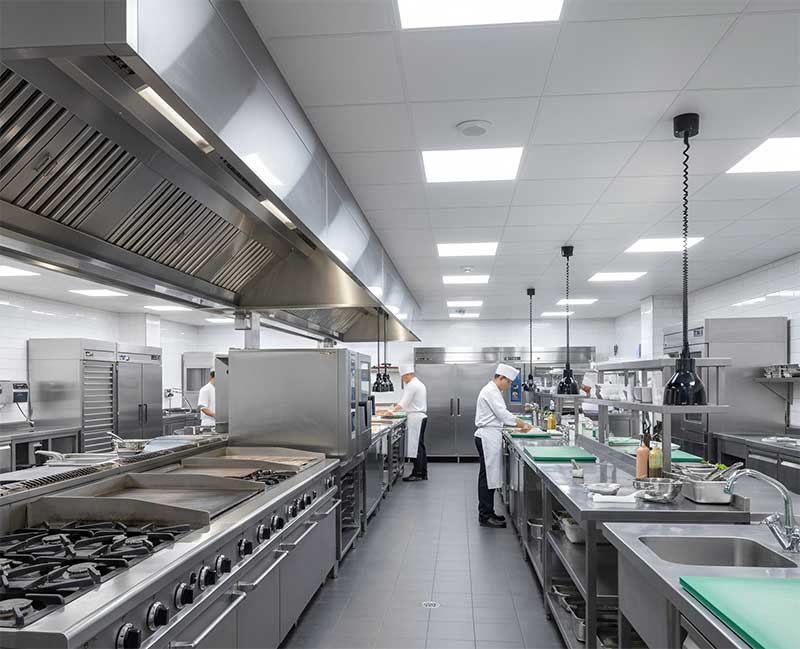
Compared with traditional kitchen air purification methods (e.g., activated carbon filtration, electrostatic precipitation), ozone treatment has obvious advantages in efficiency, cost, and maintenance:
- Grease and Odor Removal: Activated carbon filters need frequent replacement (every 1-3 months) and are ineffective against heavy grease and persistent odors, while ozone decomposes grease and odors at the source, reducing duct cleaning frequency by 60%-80% and extending the service life of ventilation equipment by 3-5 years.
- Sterilization Effect: Electrostatic precipitation can only remove particulate matter and has limited sterilization ability, while ozone achieves broad-spectrum sterilization, reducing the risk of food contamination and staff respiratory diseases. It also inhibits mold growth in food storage areas when operated at low concentrations.
- Cost-Efficiency: Although the initial investment of ozone systems is 2-3 times that of activated carbon filters (e.g., a 10 g/h ozone generator costs 3000-8000 yuan, while activated carbon filters cost 1000-3000 yuan), the annual maintenance cost of ozone systems is only 500-1500 yuan (mainly for sensor calibration and generator cleaning), which is 50%-70% lower than the annual replacement cost of activated carbon filters (2000-6000 yuan). Additionally, ozone systems utilize ambient air as raw material, eliminating the need for purchasing, transporting, or managing additional materials.
Compliance Standards and Safety Precautions
Commercial kitchens using ozone air treatment must comply with relevant international and industry standards to ensure safety and compliance. The EU EN 16282 standard, which regulates ventilation and air purification in commercial kitchens, specifies requirements for ozone system installation, maintenance, and ozone concentration limits. Key safety precautions include:
1. Ozone Leakage Prevention: Install ozone sensors in key areas (e.g., kitchen interior, exhaust outlet) to trigger an alarm and shut down the system automatically if the concentration exceeds 0.05 mg/L.
2. Professional Operation and Maintenance: Installation, repair, and maintenance of ozone generators must be performed by manufacturer-trained personnel. System components immersed in the air stream should be able to withstand a constant temperature of at least 60 °C, and the system must be easy to access for maintenance and cleaning.
3. Ventilation Coordination: Ensure the kitchen has adequate ventilation to accelerate ozone decomposition after treatment. Avoid using ozone systems when staff are present, and ventilate the space for 30 minutes before staff return.
4. Material Compatibility: Use corrosion-resistant materials (e.g., stainless steel) for components in contact with ozone to prevent equipment damage and ozone leakage due to material aging.
Practical Application Scenarios and Implementation Suggestions
Ozone air treatment solutions are suitable for various commercial kitchen types, including restaurants, hotels, central kitchens, canteens, and food processing plants. Implementation suggestions are as follows:
- For restaurants and small kitchens: Prioritize integrated ozone-exhaust systems, which are compact, easy to install, and suitable for limited space. Focus on odor removal and surface sterilization of cooking equipment.
- For central kitchens and food processing plants: Adopt centralized ozone treatment systems with multiple generators, covering the entire kitchen area and exhaust ducts. Combine with activated carbon adsorption to further reduce ozone residues and meet strict food safety standards.
- For 24-hour operating kitchens: Choose systems with intelligent control and real-time monitoring functions, adopting cyclic operation to balance purification effect and safety.
Conclusion
Commercial kitchen ozone air treatment solutions offer efficient, cost-effective, and environmentally friendly air purification, addressing the core pain points of grease, odors, and microbial pollution in commercial kitchens. By selecting the appropriate system configuration, complying with safety standards, and conducting regular maintenance, kitchen operators can improve air quality, ensure staff health, meet compliance requirements, and reduce long-term operational costs. With the increasing emphasis on food safety and environmental protection, ozone air treatment has become an indispensable technical support for modern commercial kitchen management.
-- End --
We found other products you might like!
Similar article ranking
- Ozone Generator Sizing Calculator: How to Calculate the Right Size
- 10g/h vs 20g/h Ozone Generator: Which Size Do You Need?
- Ozone Generator for Gym and Fitness Center Air Purification in 2026
- Ozone Generator Maintenance Guide: Essential Care and Troubleshooting Tips
- Ozone Generator for Swimming Pool Water Treatment: Chemical-Free Pool Sanitizati
- Commercial Ozone Generator: Complete Guide for Businesses
- How Does Ozone Work in Swimming Pool Water Treatment?
- Hotel Room Ozone Disinfection Complete Guide 2026
- Ozone Generator for Drinking Water Treatment: Complete Implementation Guide
- Ozone Generator for Semiconductor Manufacturing: High-Purity Cleaning Solutions
Ozone Equipment
- Portable Household Ozone Generator
- 50g-100g Ozone Generator
- 40g-100g ozone & oxygen machine
- SOZ-10G ozone generator
- 40g-200g ozone & oxygen machine
- OW Series Oxygen Generator
- DH-A Dryer
- Negative Pressure Ozone Generator
Ozone Application
- Residential Air purification Application
- ozone Application in wastewater treatment
- Ozone application in aquarium
- ozone Application in Pure water treatment
- Ozone Application in Aquaculture
- Ozone application in swimming pools
Latest news articles
- Ozone for Data Center Cooling Water: Biofouling Control, Energy Savings, and Sus
- How to Compare Ozone Generator Quotes: Reading Specifications Beyond the Price T
- Ozone Generator Power Supplies: How IGBT Inverter Technology Improves Output Sta
- Ozone Applications in Semiconductor Manufacturing: Wafer Cleaning, ALD Precursor
- Ozone for Pulp and Paper Mills: ECF-Complementary Bleaching, Whitewater Treatmen
- Ozone Off-Gas Destruction Systems: Thermal vs. Catalytic Destruct Units for Safe
- Ozone Sanitation for Seafood Processing Plants: Wash Water Reuse, Cross-Contamin
- Ozone vs. UV Disinfection for Water Treatment: A Practical Selection Guide for I
- Ozone Laundry Systems: How Cold-Water Ozone Washing Cuts Energy Costs for Hotels
- Total Cost of Ownership for Industrial Ozone Generators: A 10-Year Lifecycle Cos
- Ozone Mass Transfer Explained: Venturi Injectors, Bubble Diffusers, and Packed T
- Laboratory Ozone Exposure Systems: Controlled O3 Delivery for Biological, Medica
- Aquaculture Water Treatment: How Ozone Improves Fish Health and Biosecurity in C
- Case Study: Ozone Cooling Tower Retrofit Delivers 83% Chemical Savings and a 10-
- Ozone for Groundwater Treatment: Removing Iron, Manganese, and Hydrogen Sulfide
- Ozone Generator Control Systems Explained: PLC Automation, Remote Monitoring, an
- Ozone for Greenhouse Irrigation Water: Pathogen Control and Root Disease Prevent
- Industrial Ozone Systems: From 10 g/h to 200 g/h Output — A Sizing Guide for Wat
- Ozone in Pharmaceutical Water Systems: Purified Water, WFI Production, and Stora
- Industrial Ozone Generator Sizing: A Practical Calculation Guide for Water Treat