Ozone in Pharmaceutical Water Systems: Purified Water, WFI Production, and Storage Loop Sanitation
Pharmaceutical water systems are the invisible backbone of every drug manufacturing facility. Whether the end product is an injectable biologic, an ophthalmic solution, or a simple oral tablet, the quality of the purified water (PW) and water for injection (WFI) used in formulation, rinsing, and cleaning directly determines product safety. For decades, these loops relied on periodic steam sanitization or chemical biocides to control microbial proliferation. Today, an increasing number of pharmaceutical plants are integrating industrial ozone generators into their water systems as a continuous, low-temperature, residue-free sanitization method that meets the strictest global pharmacopeia requirements.
This article explains how ozone is engineered into modern pharmaceutical water systems, how it is validated against USP, EP, and ChP requirements, and what procurement engineers should evaluate when selecting a pharmaceutical-grade ozone generator for PW or WFI storage and distribution loops.
Why Pharmaceutical Water Loops Need Continuous Sanitization
Unlike municipal water, pharmaceutical-grade water is held in polished stainless-steel tanks and circulated through long distribution loops at ambient or slightly elevated temperatures. These conditions — low residual chlorine, ambient nutrient levels, and extensive wetted surface area — create an ideal environment for biofilm formation. Once established, biofilm is extraordinarily difficult to remove and serves as a persistent source of endotoxin, endospores, and Gram-negative organisms.
Regulators worldwide have responded with progressively tighter microbial action limits:
- USP <1231> and EP (2.6.30) set the alert level for purified water at 50 CFU/100 mL (TVC).
- USP <643> requires TOC below 500 ppb for PW and conductivity within 1.3 µS/cm at 25°C.
- FDA Process Validation Guidance (2011) and EMA GMP Annex 1 (2022) both expect a documented, continuous sanitization strategy for ambient PW loops.
Traditional heat-sanitized loops (typically held at 80–85°C) solve the problem thermally but consume substantial energy and accelerate oxidation of stainless-steel surfaces. Cold-loop chemical sanitization with hydrogen peroxide or sodium hypochlorite introduces residue concerns, downtime, and operator exposure. Ozone offers a third path: it disinfects continuously at ambient temperature, decomposes back to oxygen, and leaves no chemical residue.
How Ozone Works in PW and WFI Systems
Ozone is the most powerful oxidant commonly available for water treatment, with a standard redox potential of +2.07 V — well above chlorine (+1.36 V) and even ozone's hydroxyl radical decomposition pathway (+2.80 V). In a pharmaceutical water loop, dissolved ozone is delivered at a controlled residual (typically 0.02–0.10 mg/L for continuous protection, with periodic spikes to 0.3–0.5 mg/L during sanitization cycles) that rapidly inactivates bacteria, viruses, fungi, and spores while preventing biofilm adhesion.
Critically, ozone self-decomposes with a half-life of minutes at ambient temperature, reverting to dissolved oxygen. A polishing step using a 254 nm ultraviolet lamp (or a redundant catalytic destructor) reduces any residual ozone below detection before water reaches the point of use. This self-decomposition behavior is precisely why ozone is the only continuous sanitizer currently accepted by all major pharmacopeias for ambient PW loops, provided a validated residual removal step is in place.
Ozone Performance Snapshot in PW Loops
- >99.99% (4-log) reduction of P. aeruginosa, E. coli, and S. aureus within 3–5 minutes of contact at 0.05 mg/L residual
- Effective control of established biofilm on 316L stainless surfaces within 7–14 days of continuous low-level dosing
- No chlorinated disinfection by-products (no THMs, no haloacetic acids)
- Self-decomposition half-life of 15–30 minutes at 25°C, pH 7
Typical System Architecture
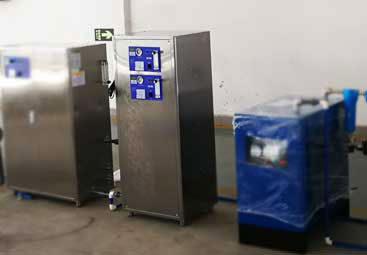
A pharmaceutical-grade ozone sanitization system is far more than an ozone generator. It is a turnkey skid integrating generation, dissolution, monitoring, and destruction. The schematic below shows the most common architecture used by Tonglin Ozone in pharma water projects:
- Feed gas conditioning: oil-free air compressor, refrigerated dryer, and adsorption desiccant (pressure dew point ≤ −40°C).
- Ozone generation: corona-discharge generator with PSA oxygen enrichment, typically rated 10–100 g/h for water-loop service.
- Mass transfer: venturi injector followed by a pressurized sidestream loop with static mixer or packed column (transfer efficiency > 95%).
- Residual control: inline dissolved ozone probe (membrane or photometric) feeding back to the generator controller.
- Residual destruction: redundant 254 nm UV chamber at the return line, sized for 2× peak flow, validated to deliver < 0.001 mg/L ozone at outlet.
- Off-gas treatment: thermal or catalytic destructor on the storage tank vent to protect laboratory air quality.
Comparison with Traditional Sanitization Methods
For procurement teams choosing between heat, chemicals, and ozone, the following table summarizes the trade-offs as documented in recent pharma installations.
| Parameter | Hot Loop (80°C+) | Chemical (H2O2 / NaOCl) | Ozone (Continuous) |
|---|---|---|---|
| Operating temperature | 80–85°C | Ambient | Ambient |
| Energy use (per m³ loop) | 3–5 kWh | 0.1 kWh + chemical cost | 0.2–0.4 kWh |
| Cycle frequency | Daily / weekly | Weekly to monthly | Continuous |
| Residual at point of use | None | Requires verified removal | None (UV destruct) |
| Operator exposure risk | Steam burn | Chemical handling | Low (closed loop) |
| Biofilm control | Effective but heat-only | Variable (resistance) | Highly effective |
Validation and Regulatory Acceptance
Ozone is explicitly cited as an acceptable sanitizer in USP <1231> and in the 2022 revision of EMA GMP Annex 1 under the broader category of "validated chemical or physical sanitization." Validation typically follows a three-phase lifecycle approach familiar to pharmaceutical quality teams:
- IQ/OQ — confirms generator performance against vendor specifications and verifies that the destruction skid reduces ozone below the limit of detection of the in-line sensor.
- PQ Stage 1 — demonstrates consistent microbial control over 4 weeks with intensive sampling at every point of use.
- PQ Stage 2 / Ongoing — routine alert/action level monitoring using both online TOC, conductivity, and ozone sensors plus periodic grab samples for heterotrophic plate counts and endotoxin.
Documented case studies from European biologic manufacturers show that switching from 80°C hot loops to ozone-maintained 20—25°C loops reduced heating-energy consumption by 85% while reducing average TVC from 12 CFU/100 mL to < 1 CFU/100 mL.
Selection Criteria for a Pharmaceutical-Grade Ozone Generator
Not every industrial ozone generator is suitable for pharmaceutical water loops. When evaluating suppliers for PW or WFI service, the following technical criteria should be mandatory:
- Material traceability: all wetted parts in 316L stainless steel with documented mill certificates and electropolished finishes (≤ 0.4 µm Ra).
- Documentation package: full IQ/OQ protocols, FAT/SAT reports, and a Declaration of Conformity referencing FDA 21 CFR Part 11 for the controller.
- Feed-gas purity: integrated oil-free compressor with multi-stage drying; dew point must be verified below −40°C to prevent nitric acid formation in the discharge cells.
- Control integration: the generator must support 4–20 mA or Ethernet/IP communication with the plant SCADA, with full audit-trail logging of every residual setpoint change.
- Redundancy: dual UV destruction lamps with independent monitoring, and an ozone destructor on all storage-tank vents.
At Tonglin Ozone, pharmaceutical-grade systems are engineered specifically against these criteria, with 21 CFR Part 11 compliant PLC controls, comprehensive mill certificates, and pre-validated IO/OQ documentation packs supplied as standard. The same engineering platform can also be specified for use in laboratory ultrapure water loops, biotech process water, and even hospital CSSD water systems.
Conclusion
Ozone has matured from an experimental sanitizer to a regulatory-accepted, energy-efficient, residue-free solution for pharmaceutical water systems. When properly engineered with redundant residual destruction and validated instrumentation, an ozone-based sanitization loop delivers continuously compliant microbial control while reducing both energy use and the operational complexity of chemical sanitization cycles. For any facility considering a new PW or WFI loop — or retrofitting an aging hot-loop system — ozone is no longer a niche option but a mainstream engineering choice.
Need an Ozone Generator for Pharmaceutical Water Treatment?
Tonglin Ozone designs and manufactures pharmaceutical-grade corona-discharge ozone generators, complete with IO/OQ documentation, 21 CFR Part 11 controllers, and integrated UV destruction skids.
Email: l810185168@gmail.com
Phone/WhatsApp: 15818868390
-- End --
We found other products you might like!
Similar article ranking
- Cooperate with well-known brand Sophos
- Ozone Generator Sizing Calculator: How to Calculate the Right Size
- 10g/h vs 20g/h Ozone Generator: Which Size Do You Need?
- Ozone Generator for Gym and Fitness Center Air Purification in 2026
- Ozone Generator for Swimming Pool Water Treatment: Chemical-Free Pool Sanitizati
- Ozone Generator Maintenance Guide: Essential Care and Troubleshooting Tips
- Commercial Ozone Generator: Complete Guide for Businesses
- How Does Ozone Work in Swimming Pool Water Treatment?
- Hotel Room Ozone Disinfection Complete Guide 2026
- Ozone Generator for Drinking Water Treatment: Complete Implementation Guide
Ozone Equipment
- Portable Household Ozone Generator
- 50g-100g Ozone Generator
- 40g-100g ozone & oxygen machine
- SOZ-10G ozone generator
- 40g-200g ozone & oxygen machine
- OW Series Oxygen Generator
- DH-A Dryer
- Negative Pressure Ozone Generator
Ozone Application
- Residential Air purification Application
- ozone Application in wastewater treatment
- Ozone application in aquarium
- ozone Application in Pure water treatment
- Ozone Application in Aquaculture
- Ozone application in swimming pools
Latest news articles
- Ozone Off-Gas Destruction Systems: Thermal vs. Catalytic Destruct Units for Safe
- Ozone Sanitation for Seafood Processing Plants: Wash Water Reuse, Cross-Contamin
- Ozone vs. UV Disinfection for Water Treatment: A Practical Selection Guide for I
- Ozone Laundry Systems: How Cold-Water Ozone Washing Cuts Energy Costs for Hotels
- Total Cost of Ownership for Industrial Ozone Generators: A 10-Year Lifecycle Cos
- Ozone Mass Transfer Explained: Venturi Injectors, Bubble Diffusers, and Packed T
- Laboratory Ozone Exposure Systems: Controlled O3 Delivery for Biological, Medica
- Aquaculture Water Treatment: How Ozone Improves Fish Health and Biosecurity in C
- Case Study: Ozone Cooling Tower Retrofit Delivers 83% Chemical Savings and a 10-
- Ozone for Groundwater Treatment: Removing Iron, Manganese, and Hydrogen Sulfide
- Ozone Generator Control Systems Explained: PLC Automation, Remote Monitoring, an
- Ozone for Greenhouse Irrigation Water: Pathogen Control and Root Disease Prevent
- Industrial Ozone Systems: From 10 g/h to 200 g/h Output — A Sizing Guide for Wat
- Ozone in Pharmaceutical Water Systems: Purified Water, WFI Production, and Stora
- Industrial Ozone Generator Sizing: A Practical Calculation Guide for Water Treat
- The 7th Generation Quartz Discharge Tube: Engineering Breakthroughs for Higher O
- Ozone for Hospital and Pharmaceutical Wastewater Treatment: Pathogen Control, AP
- Ozone in Recirculating Aquaculture Systems (RAS): Water Quality, Biosecurity, an
- Customer Case Study: Ozone Disinfection in a Beverage Bottling Plant — Water Tre
- Ozone Treatment Standards for Bottled Water Plants: A Technical Guide to FDA, IB