
What Supporting Equipment is Needed for an Ozone Generator?
What Supporting Equipment is Needed for an Ozone Generator?
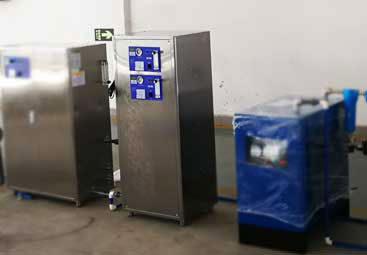
For an ozone generator to operate properly, it is not enough to simply purchase a unit and plug it in. A complete support system is required to ensure stable, safe, and efficient operation, preventing ozone leakage or equipment damage.
What Supporting Equipment is Needed for an Ozone Generator?
By function, the supporting equipment is divided into the following categories:
1. Gas Source Treatment System
Ozone generators cannot directly use ordinary air (except for small ozone units), as this results in low output and easily damages electrodes.
Air Source System: Standard configuration
Air compressor: Provides stable compressed air.
Refrigerated air dryer: Removes moisture from compressed air (ozone output is extremely sensitive to humidity).
Precision filter: Multi-stage filtration to remove oil and dust (0.1μm level). For air sources, strict de-oiling is mandatory; otherwise, oil contamination will damage discharge tubes and cause equipment failure.
Oxygen Source System: Suitable for high-concentration, high-purity applications (e.g., pharmaceuticals, water treatment)
Oxygen generator: Usually adopts PSA (Pressure Swing Adsorption) technology to raise oxygen concentration above 90%. Ozone concentration from an oxygen source can be 3–5 times higher than that from an air source.
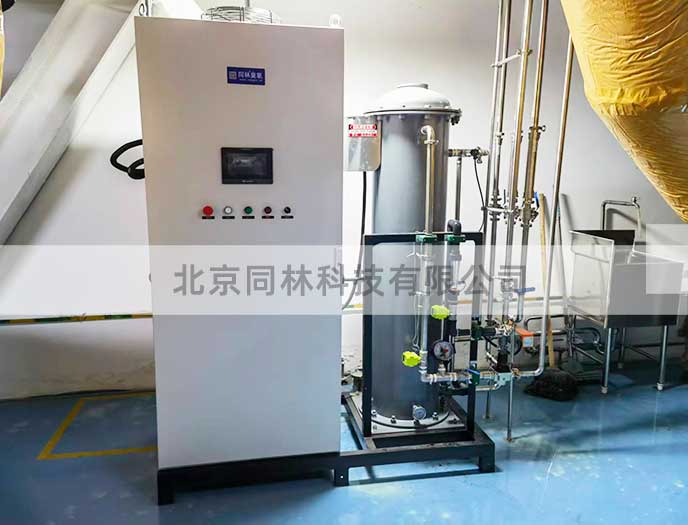
2. Cooling System
Ozone generation generates considerable heat; higher temperatures accelerate ozone decomposition and reduce yield. This is critical for equipment efficiency.
Water-cooled: Standard for medium and large units. Requires a cooling tower, circulation pump, plate heat exchanger, or chiller. Recommended cooling water temperature is below 25°C, which significantly affects ozone output.
Air-cooled: Commonly used for small units; however, water cooling is almost essential for continuous operation.
3. Dosing and Mixing System
As a strong oxidizer, ozone cannot be directly discharged into spaces or water; efficient mixing is required.
Water Treatment Applications:
Ejector (Venturi tube): Draws ozone into the water pipe via negative pressure, requires a booster pump.
Ozone mixing tower / reaction tank: Used in large-scale projects to extend contact time between ozone and water (at least 4–10 minutes), equipped with an off-gas destructor.
Space Sterilization Applications:
Distribution piping: Ozone-resistant 304 stainless steel or Teflon (PTFE) tubing.
Gas diffusers: Such as titanium aeration stones or fans, to ensure uniform ozone dispersion in the space.
4. Safety and Off-Gas Treatment System
Ozone is a hazardous gas; this section is often overlooked but vital.
Off-gas destructor: When ozone is mixed with water, actual utilization is usually below 80%, and undissolved ozone escapes from the water. The destructor decomposes residual ozone back into oxygen via thermal catalysis or activated carbon before discharge. Mandatory for enclosed spaces to avoid exceeding workplace ozone limits (national standard: below 0.3 mg/m³).
Ozone leak detector: Installed in the equipment room or potential leakage areas. Triggers an alarm and activates exhaust fans automatically when ambient ozone concentration exceeds limits.
Backflow prevention device: Check valves and anti-backflow tanks must be installed in water treatment pipelines. Water backflow into the generator due to sudden shutdown or water cutoff will burn out the power module directly.
5. Electrical and Control System
Variable frequency power supply: Usually built into modern ozone generators, but must match the input voltage.
PLC control system: An automatic control system is recommended for linked control of ozone concentration, cooling water temperature, and gas source pressure. For air sources, linked start–stop between the air compressor and generator is usually required.
Summary and Recommendations
1. For water treatment: Confirm whether an oxygen generation system (for high concentration), cooling water circulation system, and ejector/mixing tower are included in the configuration.
2. For space disinfection: Prioritize the ozone detector configuration, as it directly affects operational safety.
-- End --
We found other products you might like!
Similar article ranking
- What Supporting Equipment is Needed for an Ozone Generator?
- Glossary of terms related to ozone
- Application of ozone in cold storage
- Can ozone generator remove formaldehyde
- Swimming pool water disinfection ozone application technolog
- The application of ozone in the car wash industry
- Application of ozone generator in sewage treatment
- space disinfection equipment selecting
- How long after ozone disinfection will the air return to a s
- Ozone generator solution for disinfecting pure water and min
Ozone Equipment
- Portable Household Ozone Generator
- 50g-100g Ozone Generator
- 40g-100g ozone & oxygen machine
- SOZ-10G ozone generator
- 40g-200g ozone & oxygen machine
- OW Series Oxygen Generator
- DH-A Dryer
- Negative Pressure Ozone Generator
Ozone Application
- Residential Air purification Application
- ozone Application in wastewater treatment
- Ozone Application in Aquaculture
- Ozone application in aquarium
- ozone Application in Pure water treatment
- Ozone application in swimming pools
Latest news articles
- What Supporting Equipment is Needed for an Ozone Generator?
- Ozone generator components and functions
- Ozone generator air source comparison
- Application of ozone generator in sewage treatment
- How to ensure that ozone concentrations in clean areas are u
- How long after ozone disinfection will the air return to a s
- Application of ozone in cold storage
- Application of ozone in washing water industry
- Can ozone generator remove formaldehyde
- How to ozone disinfection of bottled water
- Ozone generator solution for disinfecting pure water and min
- Swimming pool water disinfection ozone application technolog
- The application of ozone in the car wash industry
- Glossary of terms related to ozone
- Swimming pool ozone generator sterilization principle
- space disinfection equipment selecting
- Precautions for selecting a space disinfection ozone generat
- Method for preparing ozone during swimming pool disinfection
- Warmly celebrate the 21st anniversary of BNP
- Ozone generator concentration constant constant system